Why are microwave sensors widely used in glass doors?
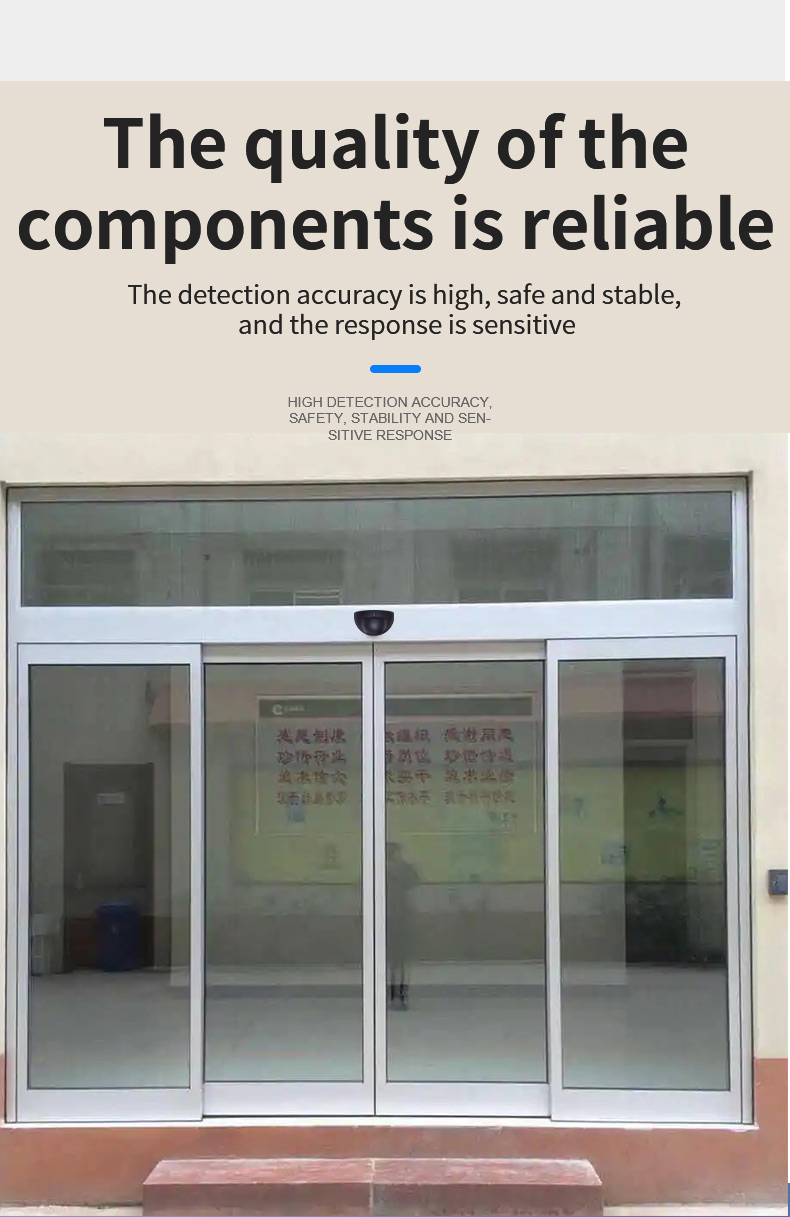
Microwave sensor widely used on glass doors (most commonly seen in automatic doors at shopping malls, hotels, banks, airports, and similar locations).
Its core function is to detect whether a person or object is approaching, thereby controlling the automatic opening and closing of the glass door.
Below is a detailed explanation of its specific functions, principles, and advantages:
I. Primary Functions
Enable Automatic Opening: When someone approaches the glass door, the microwave sensor detects human movement and immediately sends a signal to the door operator's control system, causing the door to open automatically for barrier-free access.
Prevent Pinching: During door closure, if the sensor continuously detects people or objects within the door's operational range, it immediately commands the door to stop closing and reopen, effectively preventing pinching accidents and ensuring high safety.
Maintains constant open state: During peak traffic periods, it senses continuous foot traffic and keeps the door open, enhancing passage efficiency.
Automatic smooth closing: After people leave the detection zone, the sensor delays for a few seconds (adjustable) before smoothly closing the door, conserving energy (e.g., maintaining indoor air conditioning temperature).
II. Working Principle
The microwave sensor operates based on the Doppler radar effect.
Transmit Microwaves: The sensor continuously emits high-frequency, low-power electromagnetic waves (microwaves).
Receive Echoes: These microwaves reflect off objects in front and are received by the sensor.
Signal Analysis: Internal circuitry analyzes the difference between the transmitted and reflected waves. If the object is stationary (e.g., a wall or potted plant), the reflected wave's frequency remains unchanged. However, if the object is moving (e.g., a walking person), the reflected wave's frequency shifts (known as “Doppler shift”).
Trigger Signal: Upon detecting this frequency change, the sensor determines that “a moving object has entered the detection zone” and immediately triggers the door-opening signal.
High Penetration: Microwaves can penetrate non-metallic materials like glass, thin wood panels, and plastic. This allows the sensor to be installed inside the door frame, maintaining aesthetics while remaining unaffected by outdoor weather conditions like rain, snow, wind, or dust.
True Motion Detection: It ignores stationary objects and responds only to moving targets, effectively preventing false triggers (e.g., a stationary person won't keep the door open indefinitely).
Flexible Detection Range: The detection range (distance and angle) is typically adjustable to accommodate different door types and environmental requirements.
In summary, the microwave sensor serves as the “eyes” and “brain” of automatic glass doors. By emitting and receiving microwaves to detect pedestrians, it enables automatic, safe, and intelligent door operation. This makes it an indispensable convenience and safety feature in modern architecture.


RF Converter v3.0 WIFI To Remote
2128AIO Universal Remote: Redefining the New Experience of Smart Control
Related Article